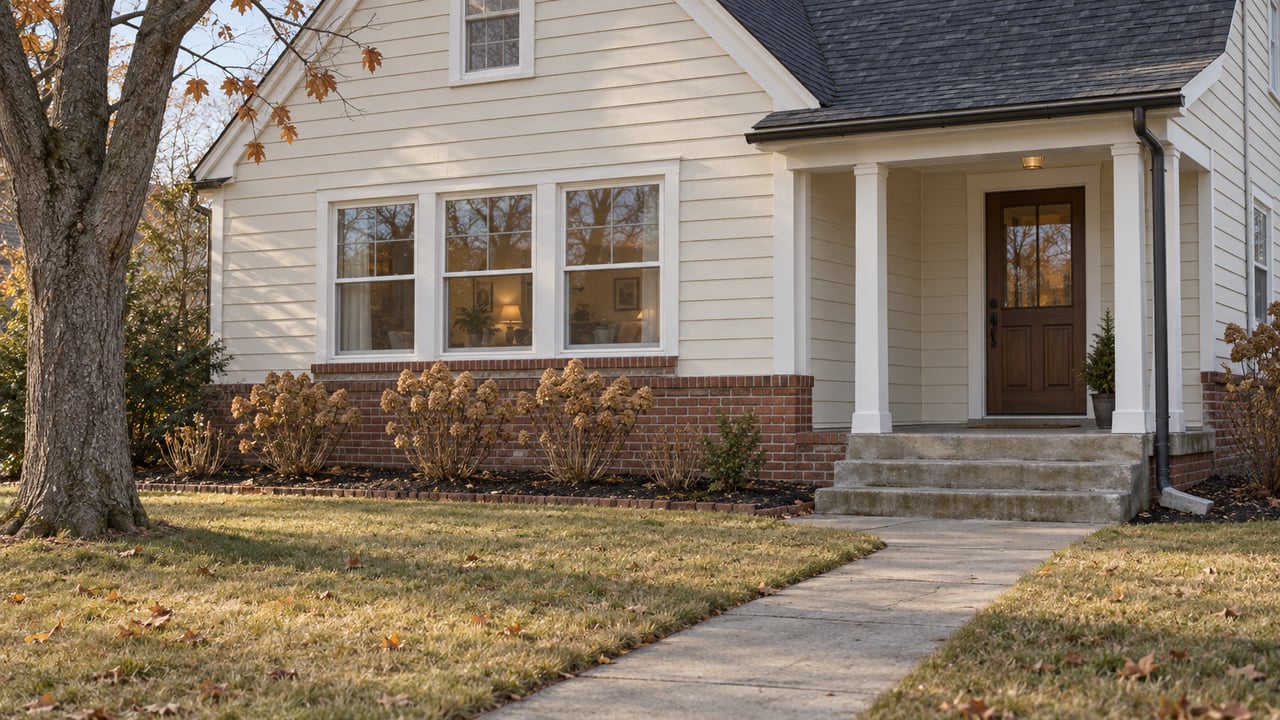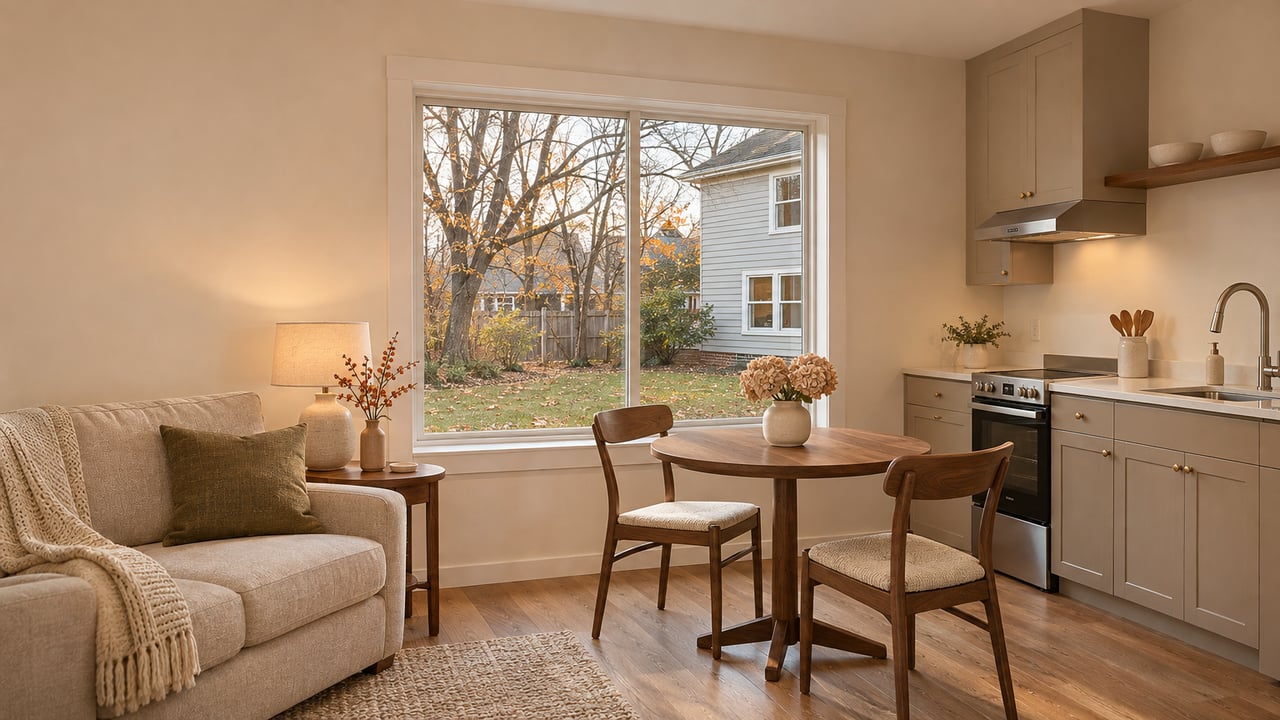
On August 20, 2019, a new building on Shirley Street NE got its occupancy permit. It has an insulated, heated garage on the ground floor and a rental apartment upstairs. The owner later published the numbers on Urban Grand Rapids. The build cost $194,500. When the whole property was refinanced in June 2020, the bank's appraiser concluded that the lot was now multi-family.
That last detail matters most to anyone shopping for a Grand Rapids home today. The city has spent two years clearing zoning barriers to accessory dwelling units, and the last round passed on June 16, 2026. Building code, utility connections, appraisal and taxes also affect a backyard unit's value.
The city's ADU zoning changes
For years, ADUs were legal in Grand Rapids but hard to build. A homeowner needed neighborhood approval, hearings and special permits, and Rapid Growth reported that only eight were built in a decade. In April 2024, the City Commission made ADUs allowed by right and dropped the rule that the owner had to live on the lot. Commissioner Jon O'Connor led that effort with support from then-Mayor Rosalynn Bliss and Planning Director Kristin Turkelson. In the following year, the city permitted as many ADUs as it had in the previous ten.
The June 2026 vote went further. Here's how the main rules have changed:
| Rule | Before the 2024 and 2026 changes | As of the August 2026 city FAQ |
|---|---|---|
| Approval | Neighborhood approval, hearings, special permits | Allowed by right on all single- and two-family lots |
| Owner lives on site | Required | Not required |
| Parking | One space per ADU, plus 0.25 space for each bedroom beyond the first | No parking requirement |
| Maximum size | 40% of the house or 400 sq ft, whichever is larger, capped at 850 sq ft | 1,000 sq ft, never larger than the main house |
| Bedrooms | Two maximum | No maximum |
| Lot's limits on sheds and garages | ADU counted toward them | ADU exempt |
The size column comes from the city's June 2, 2026 briefing to the Committee of the Whole. The owner-occupancy and parking changes appear on the city's housing policy amendments page, which summarizes the 2024 reforms. That page traces the push to a spring 2023 update of the city's housing-needs assessment, which estimated that Grand Rapids needs 14,106 more housing units.
A permitted, finished unit is still rare, and its value depends on details the listing photos won't show.
What the city's ADU FAQ says about building requirements
The city's August 2026 ADU FAQ treats an attached or detached ADU as a second dwelling under the Michigan Residential Code. It also says Michigan building codes don't distinguish between an attached two-family home and a single-family home with an attached ADU. The FAQ lists building-code and utility requirements, including:
- Its own kitchen and bathroom, separate from the main house
- Separate utility meters and electrical panels
- Separate heating and air systems for the house and the ADU
- One-hour fire-rated walls and ceilings between the two units
- A licensed residential contractor to pull permits and do the work, with licensed trades for mechanical, electrical and plumbing
- For a detached unit, a dedicated sewer connection, and preferably a dedicated water connection, with only city staff allowed to tap a live water main
- For an attached unit, a plumber's confirmation that the water service, meter and sewer lateral can handle the added demand, with extra connection fees if a larger meter is needed
Detached ADUs can't be taller than 25 feet. In a historic district, an ADU may also need a Certificate of Appropriateness from the Historic Preservation Commission.
The city's FAQ also notes that converting part of a house or an existing garage may mean altering walls and floors to meet the fire-separation rules.
The costs that come after the permit
Builders' own price lists give a sense of the money involved. MI Backyard Build was started by Grand Rapids infill developer Nathan Biller, who Rapid Growth reported owns two of the units permitted after the 2024 change. The company advertises a $3,000 stock plan, a $6,000 custom plan and an initial construction range of $150 to $300 per square foot. Survey and permit fees are extra, at about $550 to $650 each. Thornapple Construction, another area design-build firm, gives its own estimates by type: $85,000 to $180,000 for a basement ADU, $100,000 to $200,000 for a garage conversion and $200,000 to $400,000 or more for an attached addition. All of these are the builders' published ranges, not finished-project averages.
The Shirley Street account shows what happens after construction, and it's one owner's math, not a rule:
- Appraisal. The June 2020 reappraisal treated the property as multi-family, and the owner's account says that was a big part of the value increase. After subtracting the value the property would likely have gained anyway, the owner credits the ADU with about $70,423 in added value. That's roughly 36% of its $194,500 cost.
- Monthly cost. Before the refinance, payments on the ADU's loans ran just over $2,500 a month. After everything was combined into one mortgage at the roughly 3% rates of that time, the owner put the total payment at $1,776 a month.
- Property tax. From summer 2018 to summer 2020, taxable value rose 92%, from $34,753 to $66,760. With the unit rented, the state also reduced the owner's Principal Residence Exemption by 28%, matching the share of the property the owner estimated the ADU to be. The annual tax bill went from $1,209 to $2,699.
Questions about a listing's ADU claim
Rental rules add to the code requirements. The city's August 2026 ADU FAQ says leased ADUs must be registered and certified through the city's Code Compliance office, lists a 30-day rental minimum, and describes a deed restriction on selling an ADU separately from the main house. Questions about a listing's ADU include:
- Was the unit permitted as an ADU, and is there an occupancy permit?
- Does it have its own meters, electrical panel and heating and air system?
- For a detached unit, does it have its own sewer connection?
- Is the unit rented?
- Is there a recorded deed restriction?
- Has the seller's tax bill reflected a partial Principal Residence Exemption?
- How does your lender plan to appraise and underwrite a property with a second unit?
This post is general information, not legal, tax or financial advice. Rules and tax treatment depend on the property, so please confirm your situation with the city, a tax professional and your lender.
What the city is still considering
The June changes were the first batch from the city's ADU Task Force, which came up with more than 100 ideas. MLive reported that the city considered these the low-effort, high-impact steps. Other task force recommendations included two ADUs per property, ADU lot splits, short-term rentals in ADUs, permit-ready ADU plans, an ADU hub and a marketing campaign with the Grand Rapids Association of Realtors. At the June 2 discussion, Mayor David LaGrand argued for loosening the short-term rental rules, including for ADUs. MLive reported that staff planned to take that up in the broader zoning rewrite.
That rewrite is called Zone GR. Its project page lists the public review draft for fall 2026 through spring 2027. The 30-day minimum is the rule in the August 2026 FAQ.
If a Grand Rapids listing has an in-law suite, a carriage house or a big backyard you're wondering about, I'm happy to talk with you about it before you make an offer. Legacy Home Leaders can help. Let's Connect.